
Structural Biology Services
Atomic resolution structures of three-dimensional structures of proteins in their unbound states or when bound to other proteins, like antibodies, or bound to small molecule ligands.

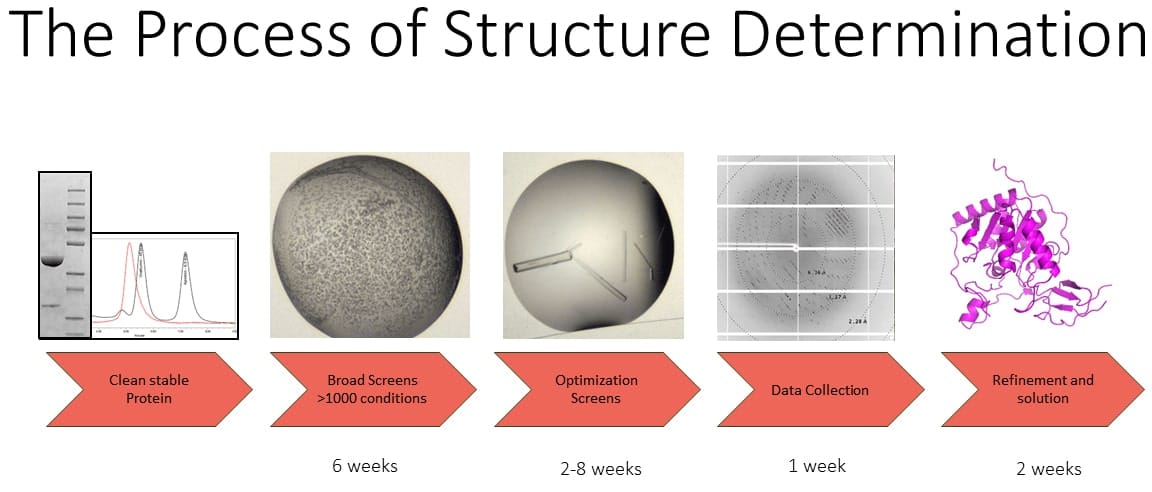
Purified and monodisperse protein preparations are screened for conditions that provide large enough crystals (>50 microns). These crystals are frozen in liquid nitrogen and analyzed at synchrotron sources to screen for crystals showing high resolution diffraction. The diffraction data is processed and a model of the protein at atomic resolution is obtained.
Primary Crystal Screening
Identification of promising crystallization conditions for protein of interest using 800-1000 conditions.
Optimization Screens
Optimize promising conditions identified from primary screens to obtain crystals.
Protein Modification
If promising conditions are not identified with the intact preparations of proteins, then the protein can be modified by either in situ proteolysis or lysine methylation. The modified protein can then be screened.
Protein-Ligand Complexes
Structures of protein-ligand complexes can be obtained by crystallizing the protein in the presence of the ligand (co-crystallization) or by soaking the ligand with crystals of the apo-protein.
X-ray Data Collection
Crystals obtained from the screens are frozen in liquid nitrogen and exposed to x-rays at synchrotron sources and the diffraction data is collected.
Structure Determination
X-ray diffraction data obtained are processed to obtain an electron density map. The electron density map together with the known protein sequence is used to obtain the three-dimensional structure of the protein.
Instrumentation

Formulatrix NT8 Crystallization Robot
The NT8 robot can be used to set up sitting drop crystallization plates under 96 different conditions. This can be used to screen 3 different protein samples on a single crystallization plate.

Rock Imager 1000
The Rock Imager 1000 provides automated imaging of crystallization plates on a pre-programmed schedule.
Frequently Asked Questions
Answers to some common questions on protein structure determination.